top of page

KUMQUAT

The 360° sound stage project was commissioned by KUMQUAT Collective, a Marseille-based collective organising tech house events. The stage was designed to accommodate the festival’s main lineup and integrate with a custom 360° sound system specifically tailored to the spatial configuration.
The project was developed with a limited budget of €1,000, requiring the reuse of materials from previous collective events. The final structure was primarily constructed from pine wood, balancing affordability, ease of assembly, and durability.

In collaboration with architect Beyram Achich, the design was developed over three weeks prior to the event, with a strong focus on creating an efficient construction system that could be quickly assembled on site.

Five days before the festival, I travelled to Marseille to participate in the physical construction of the stage by hand. This was my first experience building one of my own architectural designs, offering valuable insight into the transition from drawings to full-scale construction and the collaborative process between architects and builders.
WhatsApp Image 2026-04-03 at 15.11.32 (1).jpeg

Sketches of the site.

The site

The project took place on the grounds of an abandoned château outside Marseille, previously functioning as a women’s clinic. Composed of three buildings and surrounded by large gardens and woodland, the site offered a unique setting for the event. Hidden among the trees, the dance floors became part of the forest landscape, shaping an immersive atmosphere between sound, architecture, and nature.

WhatsApp Image 2026-04-12 at 21.04.29.jpeg

Process

Due to the limited timeframe, the design process moved directly into development. I modelled the structure in 3D, allowing us to modify elements rapidly while simultaneously producing construction drawings. This workflow helped us evaluate costs in real time and communicate the design clearly to the builders on site, ensuring the assembly process was as efficient and smooth as possible.

development process_edited.jpg

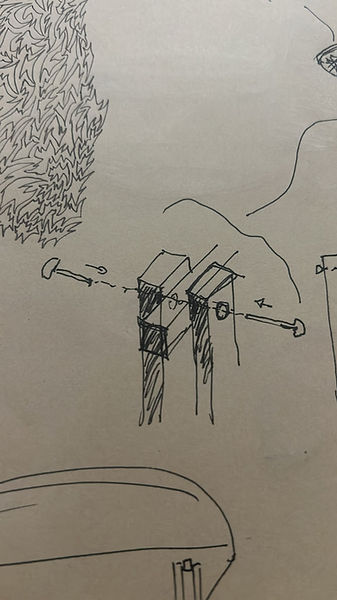
First sketches of the structure.

Process.

Reference image

The structure is composed of a four-legged system made of double wooden pillars supporting a 5-meter diameter roof. The rear pillars are extended to integrate shelving units, allowing vinyl artists to store records, equipment, and drinks directly within the structure.

The floor consists of an internal substructure covered with chipboard panels, designed to minimise wood vibration and ensure stability for the vinyl decks. The base foundation was adapted to accommodate 12 subwoofers, integrated into the lower structure to enhance the acoustic performance of the system.

Several adjustments were made on site due to construction constraints. In particular, the roof was tilted by 20 percent to enhance the overall visual dynamism of the structure and respond to spatial conditions during assembly.
render close up.png

BUILDING PROCESS

Anna Volkova 
Beyram Achich
Erwan Faucon-Lo Pinto
Tom Bini

May 2026


Sketch of the volume

Materiality

The auditorium is conceived as a self-supporting architectural object, structurallyautonomous yet anchored within the existing fabric. It rests upon the substantial wallsof the lower levels, which may be reinforced if necessary. The overall thickness of theauditorium envelope is estimated at approximately 50 cm, integrating structuralelements, acoustic insulation, and interior and exterior finishes.


Externally, the auditorium volume is enveloped in red zinc scales, extendingseamlessly across both interior and exterior surfaces. Internally, the walls are linedwith inclined MDF panels, finished with a lightly varnished blond veneer, reinforcingvisual concentration toward the stage.


Following the removal of later coatings, the original interior walls are intentionally leftexposed. Despite their material diversity and imperfect condition, this choice revealsthe historical stratification of the building, while surfaces are stabilized and preserved.


All new wall openings are marked by oblique sheets of bluish annealed steel, insertedon both sides of each passage and extending to their full height, subtly signalingmoments of transition within the historic fabric.

An initial phase of analysis was conducted using existing plans, sections, and video surveys in order to identify non -structural partitions and potential areas for intervention. Based on this analysis, new 2D and 3D documentation was produced to define the project’s volumetry. The auditorium volume was then inserted and its spatial, structural, and urban impacts evaluated.

PLAN SIENNE.jpg
orientation-01.jpg

The design of the auditorium was developed in close collaboration with scenography and acoustic consultants specialized in mixed -use performance spaces. Accommodating chamber music as well as cinema and conference functions represents a significant acoustic and spatial challenge. Chamber music requires Controlled reflections to preserve harmonic richness and sound balance, while cinema performance is primarily governed by screen dimensions and high sound absorption to prevent unwanted reverberation.

Coupe 001_AV.jpg
orientation-01.jpg
PLANE sieeg.jpg
Coupe 003_AV.jpg
orientation-01.jpg
cladding.jpg

Scale cladding

steel.png

Steel blue

Wooden acoustic pannels

Both programs demand substantial volume, height, and tiered seating, exceeding the existing heights of the large halls on level 6 of the Rector Palace.


As a result, the auditorium is designed to rise above the existing roofs. This choice is particularly sensitive due to the proximity of the Duomo and its campanile, from which the upper volume of the auditorium will be directly visible. Consequently, the form and proportions of the emerging volume are conceived with clarity and restraint, ensuring a strong architectural presence without visual excess thanks to its materiality of red zinc scales.


The auditorium is positioned neither symmetrically nor orthogonally within the space formed by the merging of the three large halls of the Rector Palace on level 6. This orientation results from a dual consideration: the diagonal viewpoint from the campanile defines the primary axis of the hall, while the desire to leave views toward the Tuscan landscape by the bays along the west and south façades establishes a strong relationship between the auditorium and its wider territorial context.

Coupes 002.jpg
orientation-01.jpg

PROJECT JOURNEY STORY BOARD

Level 4 – Access and Control

Level 4 is directly connected to the city through an independent access. From this entrance, visitors and users pass through a ticketing and control zone, where they are guided according to the program they will follow. This control zone is required to manage independent events—public or private—that take place outside the building’s general program and standard opening hours.


Despite the limited surface area of this level, a waiting room, cloakroom, and toilets are provided. To accommodate these functions and improve visitor flow, several walls have been removed or widely opened.

002 entrée_YDM.png
003 cour avec toiture.png

Level 4 – Access and Control

From this level, visitors begin their spatial journey. A ramp leads to the courtyard, from which a marble staircase and two lifts provide access to the upper floors. One lift uses an existing shaft located in the small tower at the end of the courtyard, while the second lift is fully transparent and installed in a glass shaft, offering a vertical promenade through the building. A narrow glass roof runs along the back wall to protect visitors moving toward the lifts.

Level 5 – Multipurpose Space

Level 5 is entirely dedicated to multipurpose activities. Visitors arrive via the lifts into a welcome room, where documentation related to the ongoing event can be displayed on a long desk. Adjacent spaces include a catering room and a room for restrooms and changing facilities for external staff involved in event organization.


As on the lower levels, several walls have been removed or widely opened to avoid obstacles and ensure smooth circulation during events. Public restrooms are located near the main staircase and are repeated in the same position on each level.

002 entrée_YDM.png
005 niv 06 multi Vide_YDM.png

Level 6 — Auditorium and Continuity of Spaces

Level 6 is organized into two distinct yet complementary zones. The first, located above Level 5, extends the multipurpose spaces. At the extremity of the floor, near the church, a stakeholders’ room with integrated storage is installed. This space can easily be transformed into a conference room accommodating approximately 120 seats.

Level 6 – Auditorium

The second zone reunifies the former main halls of the Rector’s Palace to host the auditorium volume. To achieve the necessary surface area, the floor of the second main hall has been reconstructed. The first main hall on this level functions as a lower lobby, providing access to the lower seating area of the auditorium through a system of steps carved into the separating wall, complemented by two ramps ensuring accessibility for people with reduced mobility.

Rouge 011 lobby level 06-rasterized.png
005 niv 06 multi Vide_YDM.png

Level 6 – Auditorium

Access to the lower auditorium follows the west façade, offering a long perspective toward the Tuscan countryside. On the opposite side, circulation runs alongside the musical instrument storage areas and artists’ changing rooms.


Within the auditorium, the walls are clad with inclined wooden panels in a natural dark blond tone. Their orientation subtly intensifies the perception of focus toward the stage while contributing to the acoustic quality of the space.

Level 7 – Upper Lobby and Outlook

A vertical wooden partition, employing the same inclined panel language, conceals the access to public restrooms and rises upward to the balcony at Level 7. Above, the vertical generosity of the space beneath the folded roof structure reveals the red zinc - scaled surface enveloping the auditorium as a singular architectural volume.

008 Lobby 07 back vide_YDM.png
Rouge 012 niv 07 entrée ouest.png

Level 7 – Upper Lobby and Outlook

At level 7, a second lobby provides access to the upper seating areas of the auditorium through offset entrances located on either side of the central projection and translation rooms.

Level 7 – Mezzanine

At Level 7 mezzanine and Level 8, VIP spaces are proposed. These rooms benefit from expansive views toward the Duomo and are conceived as flexible environments suitable for projections, conferences, exhibitions, and private events.

010 VIP.png
niv 07 vue du balcon vers la salle vide_YDM.png

Level 8 – VIP Spaces

At level 7, a second lobby provides access to the upper seating areas of the auditorium through offset entrances located on either side of the central projection and translation rooms.

Level 7 – Lobby

This lobby opens generously toward the courtyard. Exiting the auditorium through the west door, visitors are offered a framed view of the Duomo’s campanile across the courtyard, while glimpses of movement on the rooftop—accessible from the VIP mezzanine—animate the upper levels of the building.


Above the instrument storage and artists’ facilities, technical and mechanical rooms are installed beneath the roof, ensuring direct and efficient servicing of the auditorium.

014 Scene 2 Duomo.png
vues depui duomo.png

Birdview

From that level 7 mezzanine we can access on the rooftop offering two large views: on the East a direct facing one to the Duomo and on the other side toward the South West to the Toscan landscape.

In conclusion

In conclusion

This project rethinks the renovation of an exceptional heritage by preserving the existing façades and the building’s overall presence within the city. The partial interior transformation of Santa Maria della Scala, through modernization and increased openness, allows the edifice to enter a new era for both the city and its visitors, becoming a dynamic and attractive cultural hub. The proposed auditorium is conceived as a hidden gem, carefully embedded within the urban fabric, bold yet seamlessly integrated.

January 2026

bottom of page